

I hear it time and again – what are the best things to do in Durban? My home city of Durban is blessed by having an astounding depth of cultural history, and so here are my 3 must see cultural sites when visiting Durban!
Index
1. The Warwick Markets
Durban can trace it’s heritage around 3 specific groups of peoples, the British English, the Indians and the Zulu people – and all three groups are evident at the Warwick Markets.
On land originally allocated to indentured Indian workers in the late 1800’s as a site on which to establish market gardens and trade, the area quickly became established resulting in Zulu and white traders being drawn to the market to trade and to live.

By the 1930’s the local Natal Government labelled the area a slum thanks to it’s high density of stores and homes and black traders in the area.
In the 1940’s the Apartheid government began to ruthlessly enforce Apartheid laws which saw cities like Durban being classified as “white only” and Indian and Zulu traders being forced to alter or even close businesses.
Things continued along this path until the 1970’s when hawkers created the “Hawkers Action Committee” (HAC) and began protest the harassment they experienced at the hand of the Apartheid police (known locally as the “blackjacks”).
In the 1990’s the city began to change it’s attitude towards the Warwick Traders thanks in no small part to the actions of the HAC which saw the traders being not only acknowledged as being a part of the Durban community but also contributing to the city economically.
Today the Warwick Markets are made up of 9 separate markets which give fantastic insight into the history of Durban and the people. Today the area still supports tens of thousands of people directly and thousands more indirectly.
Apart from the 9 markets, places of interest include;
- the Juma Grey Street Mosque,
- Emmanuel’s Cathedral,
- The the Hazrath Badsha Peer Shrine,
- Prince’s Walk,
- Madrassa Arcade.

Visiting the Warwick Markets is perfectly safe for travellers, but you must use your common sense. There are areas of the market where photography is forbidden and it is quite easy to get lost. One of the most popular sites is the “Bead Market”, but it only operates on a Friday.
Although you can visit the markets yourself, it’s best to go with a guide, at least then you’ll understand what’s going on in the market and how it all operates.
2. Phoenix Settlement and the Ohlange Institute
Phoenix Settlement
Mohandas Karamchand (Mahatma) Gandhi came out to South Africa in 1893. He was in Durban to attend to some legal matters on behalf of local businessman and experienced for himself the racial unfairness of the period.
Once his legal business was concluded, Gandhi was extolled by the local Indian community and urged to remain in Durban and to fight for the rights of Indian people.
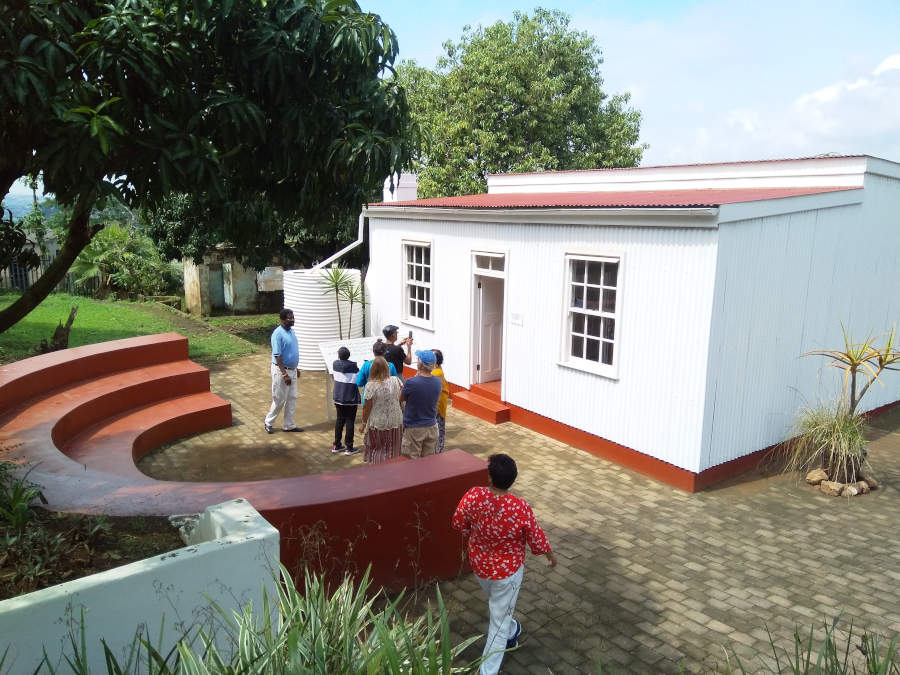
Gandhi, finding his purpose then in South Africa, travelled back to Indian and fetched his family, returning to Durban where news of his arrival had reached white ears leading to a great deal of anger within the white community.
Gandhi purchased some land outside the city of Durban and established his Phoenix settlement where he embarked on a lifetime of fighting for the rights of Indians in South Africa. He went on to establish the first Indian newspaper that resulted in the government having to soften it’s stance towards the Indian cause somewhat.
Today Phoenix settlement still survives in the township of KwaMashu. Gandhi’s original home was destroyed during the race riots of the 1970’s but has since been restored. Nearby is the house that his children grew up in and the building which housed the Indian Opinion still stands today.
You can definitely self-drive to the site but it is in a township so do take some precautions. In 25 years of conducting tours to Phoenix, I have never had a problem. Of course the best thing to do is book me for a guided tour!
Ohlange Institute
I find it fascinating the Nelson Mandela chose to cast the first free and fair election vote, not in his home town, not in parliament, not in Pretoria, Cape Town or any of those places, but rather he chose to cast his vote in KwaMashu at the home of John Langalibalele Dube, founding member of the Natal Native Congree (later, the ANC).

Dube had a fascinating life, born in 1871 in the still very rural district of Inanda, he would have had a foot in the old Zulu world and the new western influecne of the British.
Dube travelled to the United States and not only lectured but also got to meet and talk with many America leaders of the civil African rights moments.
In 1901, Dube, with the support of his wife as well as missionaries established in Durban and elsewhere, established and opens the Ohlange Institute and in 1903 begins the circulation of the newspaper “Ilanga lase Natal” which still runs today.
The home of Dube still stands today as does his school which has seen thousands of children matriculate. It’s no wonder that this is where Nelson Mandela cast his vote and visited the grave site of Durban, saying the words “I have come to report Mr President, that South Africa is now free“.
The institute is about 5 minutes away from Phoenix Settlement – it’s said that Gandhi and Dube would often meet in the surrounding sugar cane fields to discuss the matters of the day.
There is a guide on site most days, you do need to ask for him at the little security office. To see on site is the resting in place of Dube and his children, his home and the actual hall that the voting took place in.
If you would prefer a guided tour, check out my Durban Township and Freedom Trail tour for more info.
3. Durban City Centre
It may be strange that I am recommending the Durban city center as a cutlural must see site – but there is reason in my madness.
The English traders under the leadership of Farewell and company arrived in 1824 and after receiving permission from the mighty King Shaka kaSenzankhona, began trading with the local Zulu’s for ivory and animal skins.

When the ivory became scarce thanks to over-hunting, the small group f settlers turned to agriculture and so started the sugar cane industry in South Africa.
The fertile land and sizeable sugar sane fields brought both prosperity and stability to the region and so more people flooded the dirt streets and Durban and development stared.
Pretty soon, buildings were going up right left and center. Two of the best example of Edwardian neobaroque classical architecture are to be found in the Durban, the “Post Office Building” and “City Hall”.
The architectural style of the buildings echoed the prosperity of the region and included Zulu imagery – check out the allegorical figures above the main entrance.
But it’s not just those two buildings. Directly opposite city is the Cenotaph as well as the memorials to the Anglo Boer Wars, and various statues to early city founders as well as Queen Victoria.
Nearby is the Church Street markets with the flower sellers, the herb traders as well as the fresh fruit and vegetable sellers.

The Old Court House is nearby as well, and the science museum, Durban Art Gallery and Durban library are all nestled together.
In terms of culture, this is the perfect spot to admire the British determination to surround themselves with a bit of home.
You can learn a great deal more about the city centre on my Durban City Tour.
That’s All Folks!
There are many more cultural sites around Durban (and outside Durban) that I would heartily recommend you visiting, these 3 were just my favourites and I believe that all 3 together give you the best overall experience of Durban.